Between the Lines: What Richthofen's Own Flight Notes Tell Us About Staying Cool When It Counts
Most people know Manfred von Richthofen as the Red Baron — the scarlet-painted triplane, the 80 confirmed aerial victories, the legend that somehow outlived two world wars and landed smack in the middle of American pop culture. What gets talked about less is the man who sat down after missions and wrote things down.
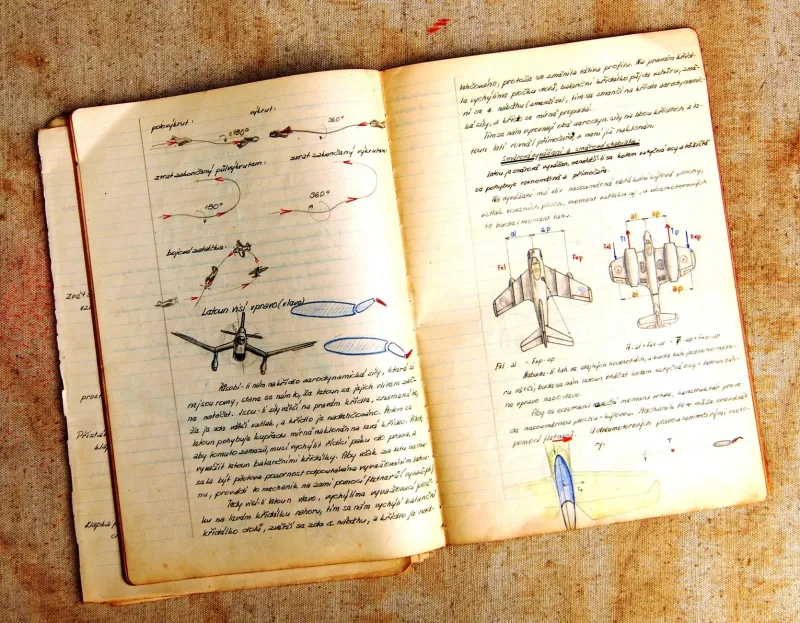
Because he did. Richthofen kept detailed personal records, correspondence, and notes throughout his combat career. And when historians and aviation researchers have taken a hard look at those documents in recent years, what they found wasn't just a war diary. It was something closer to a leadership manual written in real time, at altitude, under fire.
Here at Red Baron Flyers, we dig into exactly this kind of stuff — not just the myth, but the man behind it. So let's talk about what those records actually reveal.
The Habit of Reflection in a World That Didn't Stop Moving
One of the first things that stands out in Richthofen's personal writings is that he made time to reflect even when time was the one thing nobody had. WWI aerial combat was chaotic, fast, and brutally unforgiving. Pilots weren't expected to survive long, let alone sit down and analyze their own performance afterward.
But Richthofen did exactly that. His notes show a consistent pattern of reviewing engagements — what worked, what nearly didn't, where he had to improvise. This wasn't journaling for the sake of it. It was deliberate processing, the kind of after-action review that modern military units and high-performance business teams now build into their standard operating procedures.
For American readers who've gone through any kind of professional development training, that probably sounds familiar. It should. The idea that you debrief after high-stakes situations — not to assign blame, but to extract usable lessons — is baked into everything from Navy SEAL doctrine to Fortune 500 leadership workshops. Richthofen was doing it from a canvas-and-wire cockpit over the Western Front.
Risk Assessment Wasn't Recklessness — It Was Calculated
There's a common misconception that great fighter pilots are fearless thrill-seekers who throw caution out the window. Richthofen's own words push back hard against that idea.
His flight notes and correspondence reveal someone who thought carefully about odds. He wrote about selecting engagements where he held the advantage — altitude, sun position, numerical support — rather than diving into every fight that presented itself. He was selective, sometimes frustratingly so to his own squadronmates who wanted to mix it up more aggressively.
What's interesting is the reasoning he documented. It wasn't cowardice or hesitation. It was a clear-eyed understanding that surviving long enough to keep fighting was itself a strategic objective. He calculated risk the way a surgeon or a structural engineer might — acknowledging that some variables couldn't be controlled, and building decisions around the ones that could.
In today's language, we might call that risk-adjusted thinking. In boardrooms, on trading floors, in emergency rooms — the ability to distinguish between acceptable risk and unnecessary exposure is a skill that separates good decision-makers from great ones. Richthofen, it turns out, was documenting that skill in real time over a century ago.
Composure as a Competitive Weapon
Perhaps the most striking thread running through Richthofen's personal records is how consistently he returns to the theme of calm. Not the absence of fear — he was too honest a writer for that kind of bravado — but the disciplined management of it.
He wrote about the importance of not letting urgency override judgment. In several documented accounts, he described moments where the instinctive response would have been to react immediately and aggressively, but where pausing — even briefly — led to a better outcome. He was, in essence, training himself to insert a beat between stimulus and response.
Psychologists and performance coaches today call this the "pause principle" or something similar. The idea is that high performers, whether they're athletes, surgeons, or crisis managers, develop the ability to slow their internal clock just enough to choose a response rather than simply react. Richthofen's notes suggest he understood this intuitively and worked at it consciously.
For anyone navigating high-pressure environments in modern American professional life — think startup founders, ER physicians, military officers, or even just managers dealing with a crisis on a Friday afternoon — that's not an abstract historical footnote. It's genuinely applicable.
The Document Trail That History Almost Lost
It's worth noting that access to Richthofen's personal records has been uneven over the decades. Some documents were preserved in German archives, others scattered through private collections, and the chaos of two world wars didn't exactly create ideal conditions for careful record-keeping. Researchers piecing together a complete picture of his written legacy have had to work across multiple sources and languages.
In recent years, more rigorous academic and historical analysis has helped consolidate what's known. Aviation historians and WWI scholars have cross-referenced his personal writings with official squadron records, letters to family, and contemporaneous accounts from other pilots. The result is a more textured portrait of his thinking than the myth usually allows.
For the Red Baron Flyers community, this ongoing historical work is genuinely exciting. Every time a researcher digs deeper into the primary sources, there's a chance we learn something new — not just about the tactics or the aircraft, but about the person making the decisions.
What It Means for Us Today
Here's the honest takeaway: Richthofen wasn't writing a self-help book. He wasn't thinking about leadership frameworks or personal development. He was trying to stay alive and win a war. But the habits of mind he documented — structured reflection, calculated risk-taking, emotional discipline under pressure — happen to map almost perfectly onto what modern research tells us about high performance in demanding environments.
That's not a coincidence. It's a reminder that certain fundamentals of human performance don't change much across centuries. The technology around us evolves constantly, but the cognitive and emotional challenges of making good decisions under pressure are remarkably consistent.
For those of us who are drawn to the Red Baron's story — whether through the history, the aircraft, the culture, or the sheer audacity of what he accomplished — his personal records add a dimension that the legend alone can't provide. They show us not just what he did, but how he thought about what he did.
And honestly? That might be the most interesting part of the whole story.
Want to go deeper on the history and culture behind the Red Baron legend? Stick around — we've got plenty more where this came from.