Close Calls at 10,000 Feet: The Pilots Who Nearly Ended the Red Baron's Reign
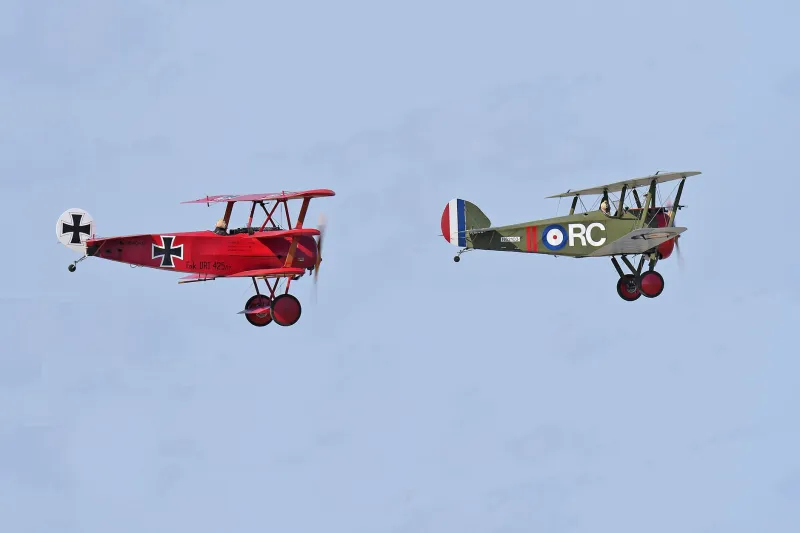
Manfred von Richthofen is the name everyone knows. The scarlet Fokker triplane, the 80 confirmed kills, the myth that grew so large it eventually swallowed the man whole. But here at Red Baron Flyers, we've always believed the most honest way to appreciate a legend is to look at the people who tested it — the ones who climbed into their cockpits, locked eyes with the most dangerous pilot in the sky, and nearly changed everything.
Because here's the thing: Richthofen wasn't untouchable. He was close to untouchable, and that distinction matters enormously.
The Pressure From Above: What Real Competition Looked Like in WWI Skies
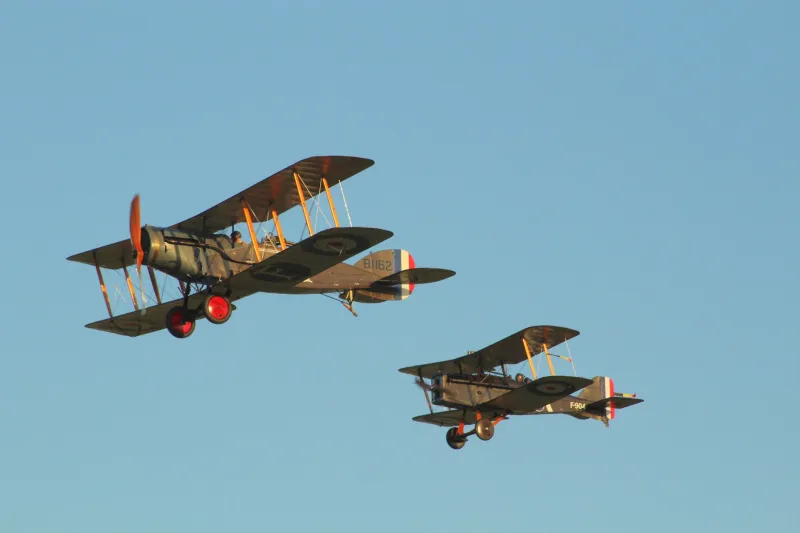
World War I aerial combat was not a clean, cinematic affair. Pilots flew in open cockpits at altitudes that froze their hands to the controls, with engines that could quit without warning and guns that jammed at the worst possible moments. In that environment, the difference between a living ace and a dead one often came down to a fraction of a second or a single degree of angle.
Richthofen understood this better than anyone. He was methodical, patient, and absolutely ruthless about only engaging when the odds favored him. But the war produced other pilots — on both sides of the trenches — who had their own versions of that ruthlessness, and several of them came close enough to shake him.
Billy Bishop: Canada's Killing Machine
If Richthofen was the war's most precise aerial tactician, Billy Bishop was its most ferociously aggressive. The Canadian ace finished the war with 72 confirmed kills, making him one of the few Allied pilots who could look at Richthofen's tally without blinking. Bishop's style was almost the opposite of the Baron's — where Richthofen stalked and calculated, Bishop attacked with a kind of controlled fury that unnerved even experienced opponents.
The two never met in a confirmed one-on-one duel, but they operated in overlapping theaters and were acutely aware of each other's presence. Bishop's ability to engage multiple enemies simultaneously and walk away — something he did repeatedly — represented exactly the kind of unpredictable threat that Richthofen's tactical system wasn't perfectly designed to handle. A pilot who doesn't follow the expected script is always the most dangerous kind.
Georges Guynemer: The Ghost the Baron Respected
France's Georges Guynemer is less familiar to American audiences, but within the aviation community, he's considered one of the most gifted natural pilots the war produced. With 54 victories and a flying style that bordered on supernatural, Guynemer was described by contemporaries as someone who seemed to become the aircraft rather than simply fly it.
There's a story — debated by historians but widely repeated — that Guynemer had Richthofen dead in his sights during an engagement and chose not to fire because the Baron appeared to be dealing with a gun malfunction. Whether or not the chivalric detail is accurate, the encounter itself reflects how close these two titans came to a decisive moment. Guynemer disappeared over Belgium in September 1917, his body never recovered. Richthofen outlived him by less than a year.
The Wound That Changed Everything
The most concrete evidence that Richthofen was mortal came on July 6, 1917, when a bullet — likely fired by British observer Albert Woodbridge from an FE2d — tore through the Baron's skull. Let that sink in for a second. The most feared pilot in the war took a head wound that temporarily blinded him and forced him to crash-land in a field while barely conscious.
He survived. He recovered. But he was never quite the same. Pilots who flew with him afterward noted that he suffered persistent headaches and seemed, at moments, less sharp than the calculating predator they'd known before. That wound didn't end his career, but it cracked the myth of invincibility wide open — and it came from a crew that most history books have largely forgotten.
Eddie Rickenbacker and the American Factor
By the time America's Eddie Rickenbacker was racking up kills in 1918, Richthofen was already operating under the physical and psychological strain of nearly four years of combat. Rickenbacker — who finished as America's top ace with 26 victories — represented a new generation of Allied pilots who were better trained, better equipped, and flying aircraft that had finally begun to close the technology gap.
Rickenbacker was also a strategist in the Richthofen mold: he studied his opponents, controlled engagements on his terms, and refused to take unnecessary risks. Had the war continued into 1919, a direct confrontation between these two would have been one for the history books. As it stands, Rickenbacker's rise symbolized the moment when Allied air power stopped playing catch-up and started setting the terms.
Werner Voss: The Rival From His Own Side
No conversation about Richthofen's rivals is complete without mentioning Werner Voss, a German ace who many contemporaries considered even more naturally gifted than the Baron himself. Voss had 48 victories when he died in September 1917, and his final dogfight — against seven British SE5s simultaneously — is still considered one of the most extraordinary single engagements in aviation history.
Voss and Richthofen were friendly rivals who pushed each other constantly, racing toward victory milestones with a competitive edge that both men acknowledged. Within the German air service, the unspoken question of who was truly the better pilot never got a definitive answer. Richthofen had the numbers; Voss had the instincts. The war didn't give them enough time to settle it.
What the Near-Misses Tell Us
For fans and collectors in the Red Baron Flyers community, these close calls aren't just historical footnotes — they're the texture of the legend. Every piece of memorabilia, every model kit, every book on the shelf carries more weight when you understand that the story almost ended a dozen different ways before it actually did.
Richthofen's 80 victories weren't inevitable. They were the product of a pilot operating at the outer edge of human capability, surrounded by opponents who were doing exactly the same thing. The rivals didn't diminish the legend — they built it, one near-miss at a time.
And honestly? That makes the whole story a lot more interesting than the myth alone ever could.