The Baron's Playbook: How Richthofen's Combat Philosophy Quietly Shaped American Military Leadership

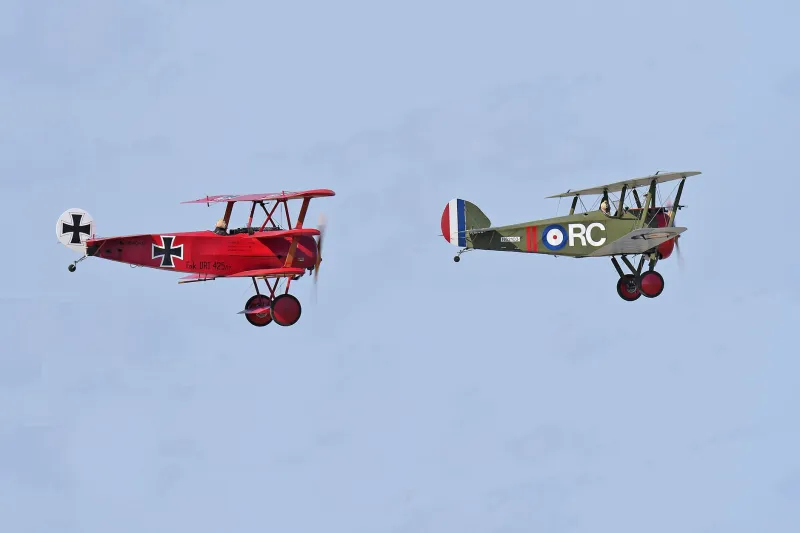
When most Americans picture Manfred von Richthofen, they see a crimson triplane banking hard through a smoky sky. Maybe they picture Snoopy on his doghouse. What they probably don't picture is a dog-eared copy of The Red Battle Flyer sitting on a shelf at the U.S. Army War College in Carlisle, Pennsylvania. But that's exactly where this story gets interesting.
Richthofen's influence on American military culture stretches well beyond the cockpit. His combat philosophy — obsessive preparation, calculated aggression, disciplined mentorship, and relentless self-assessment — has quietly worked its way into how the U.S. military thinks about leadership, strategy, and competitive advantage at every level.
More Than a Pilot, He Was a System Builder
Here's something that often gets lost in the mythology: Richthofen wasn't just a gifted flyer. He was an architect. When he took command of Jagdgeschwader 1 — the famous "Flying Circus" — he didn't just lead by example in the air. He built a culture. He documented his methods. He coached his pilots. He studied after-action reports the way a football coach studies game film.
That last point matters enormously. The Red Baron kept meticulous records of every engagement, analyzing what worked, what failed, and why. He wrote about positioning, patience, and the psychology of the enemy. He understood that winning in the air wasn't just about reflexes — it was about information, preparation, and decision-making under pressure.
Sound familiar? It should. That framework maps almost perfectly onto what the U.S. military calls the OODA loop — Observe, Orient, Decide, Act — a concept developed by Air Force Colonel John Boyd decades later. Boyd never directly cited Richthofen as a source, but military historians have noted the philosophical overlap is hard to ignore.
The War College Connection
American professional military education has a long tradition of studying adversaries, especially brilliant ones. Richthofen fits that category in an unusual way: he was an enemy of the Allied forces in WWI, yet American military educators have returned to his methods repeatedly when teaching adaptive leadership and decentralized command.
At institutions like the Air War College at Maxwell Air Force Base in Alabama and the Naval War College in Newport, Rhode Island, instructors use historical case studies to stress-test leadership theory. Richthofen's command of JG1 shows up in discussions about mission command — the doctrine of empowering subordinate leaders to make real-time decisions without waiting for orders from above. The Flying Circus operated with exactly that kind of distributed authority. Richthofen set the intent, established the culture, and trusted his pilots to execute.
That's not a WWI relic. That's current U.S. Army doctrine.
Calculated Aggression vs. Reckless Bravado
One of the most underappreciated lessons American strategists have drawn from Richthofen is the distinction between calculated aggression and reckless bravado. The Red Baron was not a cowboy. He was, by his own account, deeply conservative in the air — choosing his moments carefully, refusing to engage under unfavorable conditions, and breaking off fights when the odds shifted against him.
This runs counter to the Hollywood version of the ace pilot charging headlong into danger. And it's a distinction that defense analysts find genuinely valuable when teaching risk management to officers.
Richthofen survived as long as he did — 80 confirmed kills, the highest of any pilot in the war — not because he was the most daring, but because he was the most disciplined. He turned down glory shots. He waited. He controlled the engagement on his terms whenever possible.
That kind of strategic patience is something the U.S. military actively tries to cultivate in its officer corps, particularly at the senior levels where ego and impatience can cost lives.
Mentorship and the Multiplier Effect
Another dimension of Richthofen's legacy that military educators keep coming back to is his role as a mentor. The Flying Circus produced multiple successful aces, and that wasn't an accident. Richthofen actively developed his pilots, shared knowledge, and created an environment where learning from mistakes was normalized rather than punished.
In modern military leadership language, that's called leader development and it's considered a core competency for senior officers. The ability to replicate your effectiveness through the people you lead — what some strategists call the "multiplier effect" — is something the U.S. Army and Air Force explicitly train for.
Richthofen understood that instinctively a century before it became doctrine. His unit's collective performance was greater than the sum of its parts because he invested in his people.
The Strategic Branding Nobody Talks About
Here's one more angle that rarely makes it into the history books: the Red Baron understood information operations before anyone called them that. The red paint job on his aircraft wasn't just personal flair. It was psychological warfare. It communicated dominance, invited challengers, and built a reputation that rattled Allied pilots before the first shot was fired.
Modern military strategists study strategic communication and deterrence theory — the idea that perceived capability can shape an adversary's behavior without a fight ever happening. Richthofen was running that playbook in 1917.
The U.S. military's investment in visible demonstrations of capability — from carrier strike group deployments to airshow diplomacy — reflects the same underlying logic. Reputation is a force multiplier.
Why This Still Matters to Us
At Red Baron Flyers, we've always believed the legend runs deeper than the merchandise and the movies. Richthofen's story keeps resurfacing in serious strategic circles not because Americans are obsessed with WWI nostalgia, but because the principles he lived by are genuinely durable.
Preparation over improvisation. Discipline over daring. Leadership that develops other leaders. Strategic patience. Psychological awareness of the enemy.
Those aren't artifacts of a bygone era. They're the building blocks of effective military — and honestly, civilian — leadership in any century.
The Red Baron's triplane may be grounded permanently, but his playbook? That thing is still very much in rotation.