Built for the Kill: How the Red Baron's War in the Sky Rewrote the Rules of Aircraft Design Forever
There's a reason aviation historians keep coming back to World War I when they want to explain how modern aircraft work. It wasn't just a war — it was a brutally accelerated engineering laboratory, and nobody pushed that lab harder than Manfred von Richthofen. The Red Baron didn't design airplanes, but he flew them at the edge of their limits, demanded better ones, and inspired the engineers around him to think differently about what a combat aircraft could be. The ripple effects are still running.
The Triplane Wasn't Just a Paint Job
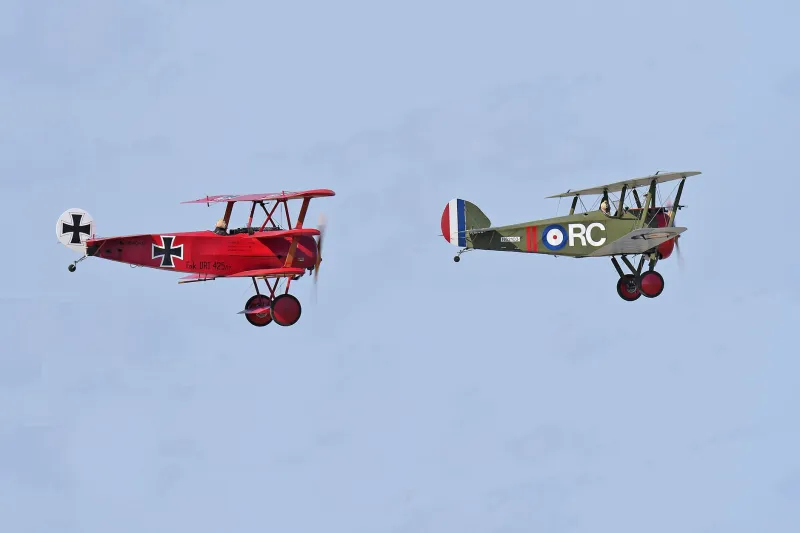
Most people picture the Red Baron and immediately see red. That iconic crimson paint scheme on his Fokker Dr.I triplane is one of the most recognizable images in aviation history, and it wasn't just vanity. The color served a psychological purpose — it made Richthofen instantly identifiable in a chaotic sky, both to his own squadron and to the enemy. That idea, using visual identity as a tactical tool, planted a seed that would grow into everything from military aircraft markings to the nose art tradition that American bomber crews made famous in World War II.
But the triplane itself was the real engineering story. The three-wing configuration gave the Fokker Dr.I an extraordinary rate of climb and tight turning radius compared to the biplanes of the day. It sacrificed top speed for maneuverability, a tradeoff that forced designers on both sides to ask a fundamental question that still drives aerospace engineering: what do you optimize for? That question — speed versus agility, range versus responsiveness — is the same one engineers wrestle with when they're spec'ing out an F-22 Raptor or even a modern commercial airframe. Richthofen's era didn't answer it, but it made sure everyone was asking.
Tactics That Became Engineering Requirements
Here's where it gets really interesting. The Red Baron's combat philosophy wasn't just about personal skill. He documented his methods, trained his squadron — the famous Flying Circus — and created repeatable approaches to aerial combat. Those approaches told engineers exactly what they needed to build.
Richthofen preferred attacking from above and behind, diving on enemies out of the sun, then breaking away before they could react. That style demanded specific things from an aircraft: quick throttle response, predictable handling at high angles of attack, and the structural integrity to survive steep dives. When engineers started receiving feedback from pilots about what was killing them and what was keeping them alive, those requirements got baked into design specifications. The structural load calculations that came out of WWI dogfighting directly influenced how engineers thought about airframe stress in the decades that followed.
The concept of energy management in aerial combat — conserving altitude and speed as tactical resources — traces back to this era. Later American aviation theorist John Boyd would formalize it into what he called the OODA loop and energy-maneuverability theory, work that shaped the design of the F-16. But Boyd was building on a foundation that pilots like Richthofen had laid in the skies over France.
The Synchronization Problem and What It Unlocked
One of the most consequential engineering breakthroughs of the WWI era was the synchronized machine gun — a mechanism that let pilots fire through a spinning propeller without shooting off their own blades. The Germans had refined this technology, and Richthofen used it to devastating effect. But the deeper legacy wasn't the gun itself. It was the mindset shift it represented.
For the first time, the airplane and its weapons system had to be designed together as an integrated unit. You couldn't just bolt a gun onto a flying machine and call it a fighter. The propeller timing, the gun mechanism, the pilot's sight line — everything had to work as one system. That integrated systems thinking is now so fundamental to aerospace engineering that it's hard to imagine the field without it. Modern fighter jets are essentially flying computers where the airframe, engines, avionics, and weapons are all co-designed from day one. That philosophy has roots in the synchronization gear debates of 1915 and 1916.
Paint Schemes, Radar, and the Long Game
The Red Baron's red aircraft also kicked off a conversation about aircraft visibility that took some unexpected turns. After WWI, military strategists started thinking seriously about the flip side of Richthofen's bold coloring — what if you wanted your aircraft to be invisible instead of iconic? The interwar period saw serious experimentation with camouflage schemes, and that work accelerated dramatically in WWII.
Fast forward to the Cold War and the development of stealth technology, and you've got the ultimate answer to the visibility question. The B-2 Spirit bomber and the F-117 Nighthawk weren't just engineering achievements — they were the logical endpoint of a conversation that started when someone asked why Richthofen painted his plane red. The question of how an aircraft is perceived — visually, on radar, acoustically — is now one of the central challenges in military aerospace design.
Commercial Aviation's Quiet Debt
It might seem like a stretch to connect the Red Baron to your next flight out of O'Hare, but the link is real. The aerodynamic research that WWI combat flying accelerated — wing loading, lift-to-drag ratios, structural limits — fed directly into the post-war commercial aviation boom. Engineers who had spent the war years pushing aircraft to their limits didn't stop thinking about those problems when the armistice came. They took what they'd learned into the nascent commercial aviation industry.
The understanding of how wings behave under stress, how engines respond to rapid throttle changes, and how pilots interact with aircraft controls — all of it was sharpened by the brutal efficiency of aerial combat. Every time you board a plane and it handles turbulence without shaking itself apart, you're benefiting from engineering knowledge that has WWI fingerprints on it.
The Baron's Blueprint
Richthofen was killed in April 1918, and the war ended seven months later. But the questions his flying raised — about speed, agility, visibility, integration, and the relationship between pilot and machine — never stopped being relevant. They just kept getting answered with better tools and bigger budgets.
For the aviation enthusiast community, that's part of what makes the Red Baron more than just a historical curiosity. He wasn't just a great pilot. He was an early stress-tester of a technology that would reshape the 20th century. Every generation of aircraft designers has been, in some small way, responding to the problems that Richthofen and his contemporaries identified in the skies over the Western Front.
That's a legacy worth knowing about — whether you're a collector with a Fokker Dr.I model on your shelf or just someone who looks up every time a fighter jet screams overhead.