Throttle, Angle, Kill: Breaking Down the Aerial Chess Game That Made Richthofen Unstoppable
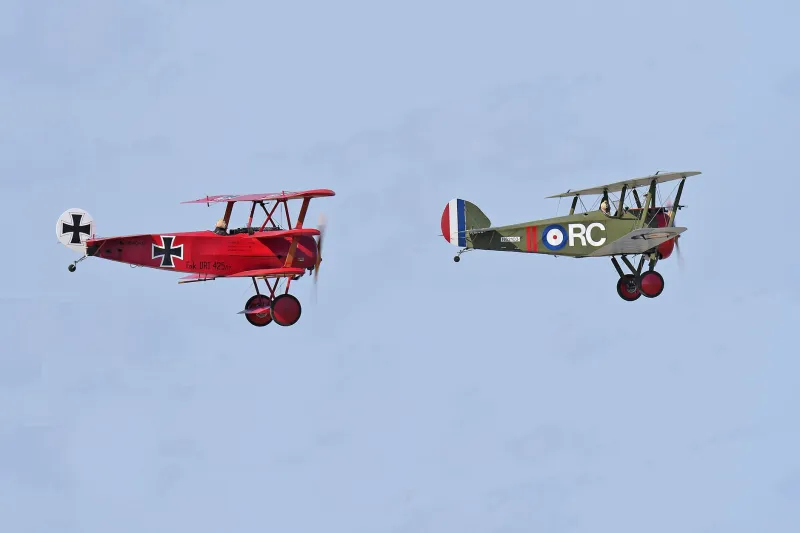
Most people know the Red Baron as a name — a legend stamped on frozen pizza boxes and Snoopy comic strips. But spend five minutes talking to anyone who actually teaches air combat maneuvering, and you'll hear something that stops you cold: Manfred von Richthofen's tactical instincts weren't just good for 1917. Some of them are still being drilled into fighter pilots today.
Not as history lessons. As technique.
So let's do something a little different here at Red Baron Flyers. Instead of talking about the myth, let's talk about the mechanics. What, specifically, did Richthofen do up there that made him the most lethal aerial combatant of his era? And which pieces of his playbook survived a century of jet engines, radar, and beyond-visual-range missiles?
The Altitude Advantage: He Owned the High Ground Before the Fight Started
Richthofen was obsessive about entering an engagement from above. This wasn't vanity — it was physics. An aircraft with altitude has potential energy that can be converted instantly into speed. Diving on a target means arriving faster, with more kinetic energy, and with the sun often at your back.
This concept — turning altitude into speed and speed into positional dominance — is called energy management in modern ACM (Air Combat Maneuvering) doctrine. Instructors at Top Gun (officially the Naval Aviation Warfighting Development Center in Fallon, Nevada) still frame engagements around energy states. A pilot who enters a fight with more energy has more options. Richthofen understood this intuitively a full century before the term existed in any syllabus.
He would climb patiently, wait for the geometry to favor him, and only commit when he held the energy advantage. Patience, it turns out, is a tactical weapon.
The Ambush Architecture: He Didn't Chase, He Trapped
Here's something that gets lost in the romantic retelling: Richthofen rarely went looking for a fair fight. He engineered unfair fights — and that was the whole point.
His preferred method was to position his Jagdstaffel (fighter squadron) between enemy aircraft and their home airfields, using cloud cover and sun angle to mask their approach. By the time a British or French pilot spotted the red Fokker, the geometry was already broken in Richthofen's favor. The target had limited escape vectors. The attack was already half-finished before the trigger was pulled.
Modern strike planners call this kind of pre-engagement maneuvering "setting the conditions." You don't win a dogfight in the merge — you win it in the ten minutes before the merge. Richthofen was a master of that invisible phase of combat.
Turn Radius and the Scissors: Exploiting What Your Aircraft Does Best
Richthofen flew multiple aircraft during his career, but he was meticulous about understanding the specific performance envelope of whatever he was flying. He knew his turn radius. He knew his climb rate. He knew exactly where his plane outperformed the enemy's — and he built his attack sequences around those windows.
The Albatros D.III, one of his earlier mounts, had a tighter turn radius than many Allied fighters of the period. Richthofen exploited this relentlessly. When an enemy tried to extend and run, he'd cut the corner. When they tried to turn inside him, he'd force an overshoot and reverse.
This is textbook angles fighting — a discipline still taught in every serious fighter weapons school in the US military. The F-16 and F/A-18 communities have entire syllabus blocks dedicated to turn rate vs. turn radius tradeoffs. The vocabulary is different. The math is more precise. But the underlying logic? Richthofen would recognize it immediately.
The Short Burst Doctrine: He Didn't Spray, He Placed
One detail that gets overlooked in the legend-building: Richthofen was extraordinarily disciplined with his ammunition. He didn't open fire at long range and hope. He closed to what he considered a certainty range — often uncomfortably close by any reasonable standard — and fired short, deliberate bursts.
His personal records and letters make clear that he viewed marksmanship as the final expression of everything else: the positioning, the energy management, the patience. Getting to the right angle was the hard part. The shooting was almost mechanical once the geometry was correct.
Modern gunnery doctrine echoes this almost word for word. Gun employment in close-in maneuvering combat requires solution discipline — firing when the conditions are met, not when the adrenaline says go. Instructors at Luke Air Force Base and Naval Air Station Oceana have described this exact principle to aviation journalists over the years. Richthofen, operating with a synchronized machine gun and no computerized gunsight, applied it purely through feel and experience.
What He Couldn't Have Known — And What Still Doesn't Apply
Fair is fair: some of Richthofen's tactical world doesn't translate. Modern BVR (beyond-visual-range) combat, stealth geometry, electronic warfare, and missile employment exist in a completely different problem space. The Red Baron never had to think about radar cross-section or missile kinematic envelopes.
And the scale is different. Richthofen operated as an individual hunter-killer, occasionally coordinating a small formation. Modern air operations involve integrated battlespace management, data links, and distributed decision-making that would be unrecognizable to any WWI pilot.
But here's the thing: when modern engagements do go to the merge — when two aircraft end up in a visual, close-range turning fight — the physics haven't changed. Energy is still energy. Angles are still angles. Patience and positioning still beat raw aggression. And that's exactly where Richthofen's instincts remain stubbornly, almost eerily, relevant.
Why This Matters to Us
At Red Baron Flyers, we're obviously fans first. But part of what makes Richthofen's story so enduring isn't just the mythology — it's that the substance behind the myth holds up. He wasn't just lucky. He wasn't just fearless. He was a systematic, analytical combat pilot who reverse-engineered aerial killing into a repeatable process.
That's why his name is still in the conversation a hundred years later. Not because of the red paint on his plane. Because of what he did with it.
Next time you see the Red Baron's image on a product or a poster, maybe think about what's actually being honored there — not just a dashing WWI ace, but one of the most tactically sophisticated pilots who ever lived. That's a legacy worth understanding, not just celebrating.